

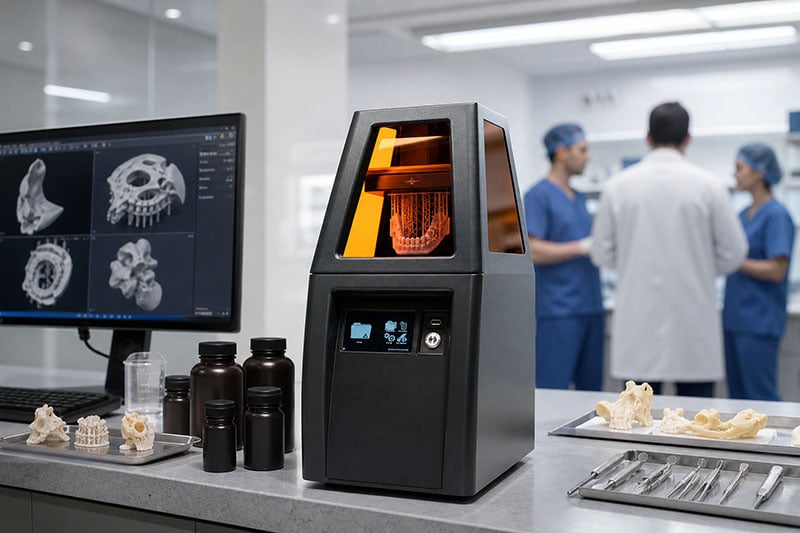
When a surgical team prepares for a complex orthopedic procedure, every millimeter matters. The surgical guide needs to fit the patient's anatomy exactly—no guesswork, no adjustments mid-operation. This is where micro 3D printing changes everything for medical device manufacturers.
B9Creations helps medical teams produce surgical guides and anatomical models with the precision and material options these applications demand. In this guide, you'll learn how to evaluate micro 3D printers for your medical R&D needs, from resolution requirements to biocompatibility standards.
Whether you're prototyping a new surgical guide design or producing patient-specific anatomical models for surgical planning, this resource covers the critical selection criteria you need to make informed decisions.
What Is Micro 3D Printing for Medical Devices?
 Micro 3D printing refers to additive manufacturing technologies capable of producing parts with feature sizes below 100 microns. For medical device applications, this level of precision allows engineers to create detailed surgical guides, intricate anatomical models, and small-scale prototypes that match patient CT or MRI data.
The technology uses various processes, including digital light processing (DLP), stereolithography (SLA), and projection micro stereolithography. DLP systems in particular excel at producing high-resolution parts quickly, making them a popular choice for medical R&D teams working under tight deadlines.
Unlike traditional manufacturing methods, micro 3D printing allows you to iterate designs rapidly. You can test a surgical guide design in the morning and have a printed prototype ready for evaluation by afternoon.
How Micro 3D Printing Differs from Standard 3D Printing
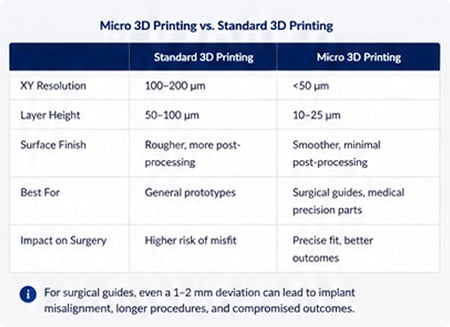
Standard desktop 3D printers typically achieve layer resolutions of 50-100 microns with XY resolutions around 100-200 microns. Micro 3D printers push these limits significantly lower, with some systems achieving layer heights of 10-25 microns and XY resolutions below 50 microns.
For surgical guide manufacturing, this difference matters tremendously. A guide with imprecise fit can lead to instrument placement errors, extended procedure times, and compromised patient outcomes.
The surface finish also differs substantially. Medical applications often require smooth surfaces that won't irritate tissue or harbor bacteria. Micro 3D printing produces parts with surface finishes that minimize post-processing requirements.
Why Surgical Guide Manufacturing Requires Micro-Scale Precision
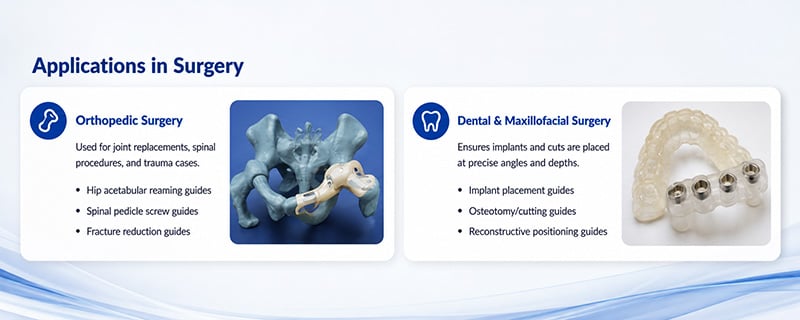
Surgical guides are custom tools that help surgeons position instruments, implants, or cutting tools with accuracy during procedures. In orthopedic surgery, dental implant placement, and cranio-maxillofacial procedures, guides ensure that the surgical plan translates precisely to the operating room.
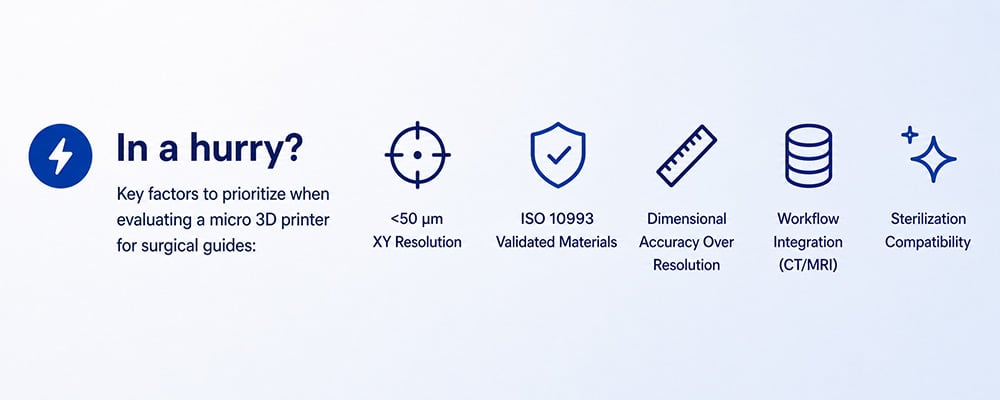
The fit between a surgical guide and the patient's bone surface must be exact. Even small deviations—a millimeter or two—can result in misaligned implants or improperly positioned cuts. This makes resolution and dimensional accuracy critical selection criteria when choosing a micro 3D printer.
Applications in Orthopedic Surgery
Orthopedic surgeons use patient-specific surgical guides for joint replacements, spinal procedures, and trauma cases. A hip replacement guide might define the exact angle and depth for the acetabular reamer. A spinal guide might position pedicle screw entry points based on the patient's vertebral anatomy.
Creating these guides requires software that converts CT scan data into printable 3D models, paired with a printer capable of reproducing fine anatomical details. The B9 Core Series, including the Med and Dent Series, integrates into this workflow, allowing medical device teams to move from imaging data to physical prototype efficiently.
Applications in Dental and Maxillofacial Surgery
Dental surgical guides position implants at precise angles and depths determined by preoperative planning software. A guide that fits poorly on the patient's dentition leads to implant placement errors that are difficult or impossible to correct.
Maxillofacial surgeons use cutting guides and positioning guides for reconstructive procedures. These guides often include multiple components that must align with sub-millimeter accuracy across the patient's facial skeleton.
Understanding Biocompatible Materials for Medical 3D Printing
Any 3D printed component that contacts patient tissue—even briefly during surgery—must be manufactured from biocompatible materials. Biocompatibility means the material won't cause adverse biological reactions when in contact with living tissue.
For surgical guides used in the operating room, this typically means materials certified to ISO 10993 standards for biological evaluation of medical devices. The specific ISO 10993 tests required depend on the duration and type of tissue contact.
Key Biocompatibility Standards for Surgical Guides
ISO 10993-5 covers cytotoxicity testing to ensure the material doesn't kill or damage cells. ISO 10993-10 addresses irritation and skin sensitization. For devices with mucosal contact, ISO 10993-1 provides guidance on selecting the appropriate test matrix.
When evaluating biocompatible 3D printing materials, look for complete documentation of ISO 10993 testing from the material supplier. Don't assume that a material marketed as "biocompatible" meets the specific requirements for your intended use.
Material Options for Surgical Guide Production
Photopolymer resins dominate the surgical guide market due to their excellent detail reproduction and availability in biocompatible formulations. These materials cure under UV or visible light exposure during the printing process.
Some applications require sterilization-compatible materials that maintain dimensional stability through autoclave cycles. Others may need materials with specific mechanical properties—flexibility for certain soft tissue applications, or rigidity for bone-referenced guides.
B9Creations offers validated material options through the B9 Core Med Series, B9 Core Series, B9 Elite Micro Series, and B9 Dent Series, and is also open to third-party materials as needed for surgical guide and anatomical model production.
How to Evaluate Resolution and Accuracy for Medical Applications
When comparing micro 3D printers for surgical guide production, you'll encounter various resolution specifications. Understanding what these numbers mean—and how they translate to real-world part quality—helps you make informed purchasing decisions.
XY Resolution vs. Z Resolution
XY resolution describes the smallest feature size the printer can produce in the horizontal plane. For DLP printers, this is determined by the pixel size of the projector and the optical system. A printer with 30-micron XY resolution can produce features as small as 30 microns in the XY plane.
Z resolution refers to the layer height—the vertical distance between each cured layer. Smaller layer heights produce smoother surfaces and better reproduction of curved geometry, but increase print time proportionally.
For surgical guides, both specifications matter. XY resolution affects how well the guide reproduces fine anatomical details. Z resolution affects surface finish and the accuracy of angled features.
Dimensional Accuracy vs. Resolution
A printer may have excellent resolution but poor dimensional accuracy. Resolution gives an indicator of feature size; accuracy describes how closely the printed part matches the intended dimensions from your CAD file.
Medical applications demand both. A surgical guide might require 50-micron features (resolution) that are positioned within 100 microns of their intended locations (accuracy). Ask vendors for dimensional accuracy specifications and request sample parts you can measure.
Testing Printer Performance for Your Applications
The best way to evaluate a micro 3D printer is to print actual surgical guide geometries and measure the results. Request evaluation prints of your designs, or use standardized test geometries that stress the printer's resolution and accuracy capabilities.
Measure critical dimensions using calibrated instruments—calipers for larger features, optical measurement systems or CMMs for fine details. Compare measured values against your CAD specifications.
Workflow Integration for Medical Device Prototyping
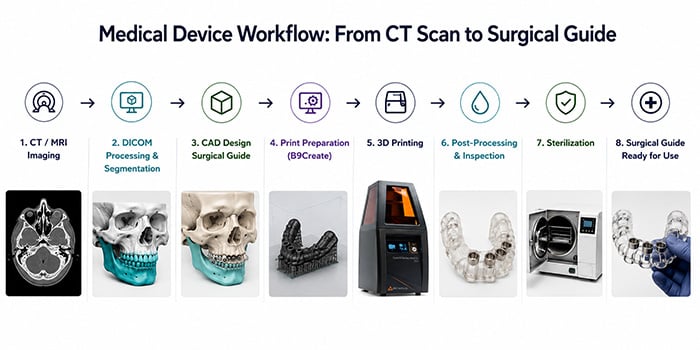
A micro 3D printer doesn't operate in isolation. It's part of a workflow that begins with medical imaging data and ends with a sterilized, ready-to-use surgical guide. Understanding how the printer integrates with your existing systems helps you evaluate true costs and efficiency.
From CT/MRI Data to Printable Models
The workflow typically starts with DICOM imaging data from CT or MRI scans. Segmentation software converts this data into 3D surface models representing the patient's anatomy. Design software adds the guide features—drill bushings, cutting slots, registration surfaces.
The final design exports as an STL or similar file format for the 3D printer. The printer's slicing or CAM software prepares the model for printing—orienting the part, generating supports, and calculating the layer-by-layer build sequence.
B9Create software streamlines this preparation process, handling orientation, support generation, and production settings in a unified interface that medical device engineers can learn quickly.
Post-Processing Requirements
After printing, most photopolymer parts require washing to remove uncured resin, followed by post-curing under UV light to complete the polymerization process. Some applications then require support removal, surface finishing, and inspection.
For surgical guides, post-processing must maintain the dimensional accuracy achieved during printing. Aggressive support removal or excessive post-cure times can distort the part. Establish validated post-processing protocols for each material and application.
Sterilization Considerations
Surgical guides used in the operating room must be sterile. Common sterilization methods include steam autoclaving, ethylene oxide (EtO) gas, and gamma irradiation. Not all 3D printed materials tolerate all sterilization methods.
Autoclaving exposes parts to steam at 121-134°C under pressure. Materials must maintain dimensional stability at these temperatures. EtO sterilization operates at lower temperatures but involves extended cycle times and aeration periods.
Validate that your chosen material maintains critical dimensions through your intended sterilization process. Print test parts, sterilize them using your standard protocol, and measure critical dimensions before and after.
3D Printed Anatomical Models for Surgical Planning
Beyond surgical guides, micro 3D printing enables the production of high-resolution anatomical models for preoperative planning, patient education, and surgical simulation. These models help surgeons visualize complex anatomy and practice procedures before entering the operating room.
Creating Patient-Specific Anatomical Models
The workflow parallels surgical guide production: segment patient imaging data to create 3D surface models, then print those models at appropriate scale. For complex anatomy—such as congenital heart defects or vascular malformations—high resolution is essential to capture the clinical details.
Multi-material printing can represent different tissue types within a single model. You might print bone in one material and soft tissue in another, creating a model that simulates the actual surgical environment more realistically.
Benefits for Surgical Team Preparation
3D printed anatomical models allow surgical teams to plan approaches, identify potential challenges, and coordinate roles before the procedure begins. For complex cases, this preparation can reduce operative time and improve outcomes.
Models also support patient communication. Showing a patient a physical model of their anatomy—and the planned surgical approach—helps them understand the procedure and make informed consent decisions.
Regulatory Considerations for 3D Printed Surgical Guides
Medical devices, including 3D printed surgical guides, are regulated by the FDA in the United States and by equivalent bodies in other jurisdictions. Understanding these regulatory requirements helps you design compliant products and documentation systems.
FDA Classification of 3D Printed Surgical Guides
The FDA classifies most patient-matched surgical guides as Class II medical devices under product code HWB. Class II devices require 510(k) premarket notification unless they qualify for an exemption.
Point-of-care manufacturing—where hospitals or surgery centers print guides on-site rather than receiving them from a commercial manufacturer—involves additional regulatory considerations. The FDA has published guidance documents addressing this emerging manufacturing model.
Quality System Requirements
Manufacturers of 3D printed medical devices must maintain quality management systems compliant with 21 CFR Part 820 (FDA Quality System Regulation) and/or ISO 13485. These systems cover design controls, production controls, and documentation requirements.
For 3D printing specifically, quality systems should address material traceability, printer calibration, process validation, and inspection procedures. Document your processes thoroughly—regulatory auditors will want to see evidence that you control your manufacturing process.
International Regulatory Frameworks
Outside the US, the European Union's Medical Device Regulation (MDR) governs medical device approvals. Other major markets—Japan, China, Brazil, Australia—have their own regulatory frameworks that may require additional testing or documentation.
If you plan to market your surgical guides internationally, work with regulatory consultants familiar with each target market's requirements. Requirements vary significantly, and what satisfies FDA may not satisfy other regulatory bodies.
Selection Criteria for Micro 3D Printers in Medical R&D
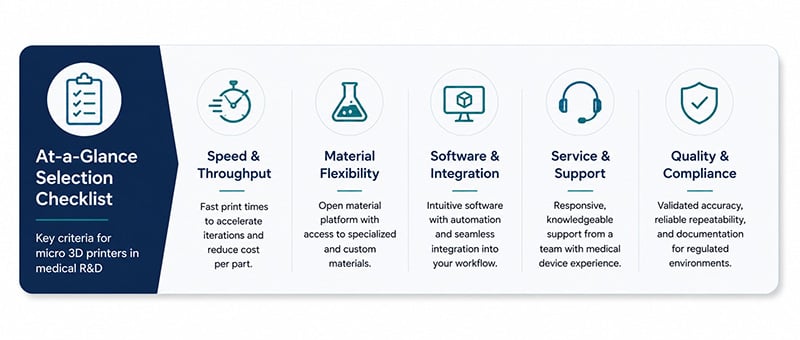
When evaluating micro 3D printers for surgical guide and anatomical model production, consider these key criteria beyond basic resolution specifications.
Print Speed and Throughput
Print speed matters for efficiency and production economics. Faster printers allow more design iterations per day and reduce the cost per part for production applications.
DLP technology typically offers speed advantages over laser-based systems because it cures entire layers simultaneously rather than tracing each feature with a laser beam. The B9 Core Series delivers printing speeds 4x faster than many alternatives, allowing medical device teams to accelerate their development cycles.
Material Flexibility and Availability
Different applications may require different materials. A printer that locks you into proprietary materials from a single supplier limits your options and may increase your ongoing material costs.
Look for systems compatible with third-party materials, especially if you anticipate specialized requirements—flexible materials, high-temperature materials, or materials with specific mechanical properties. B9Captivate material development tools let you optimize settings for custom materials tailored to your specific applications.
Software Capabilities and Integration
Evaluate the printer's CAM software for ease of use, automation capabilities, and integration with your existing design tools. Software that requires extensive manual intervention for each print job adds labor costs and increases error opportunities.
Consider whether the software supports batch production, automated support generation, and documentation features that support quality system requirements.
Service and Support
Medical device development often operates under deadline pressure. When printer issues arise, you need rapid, competent support. Evaluate vendors based on their support infrastructure, response times, and technical expertise.
Ask for references from other medical device customers and inquire about their support experiences. A vendor that excels with jewelry or dental customers may lack experience with medical device regulatory requirements.
 How B9Creations Supports Medical Device Manufacturing
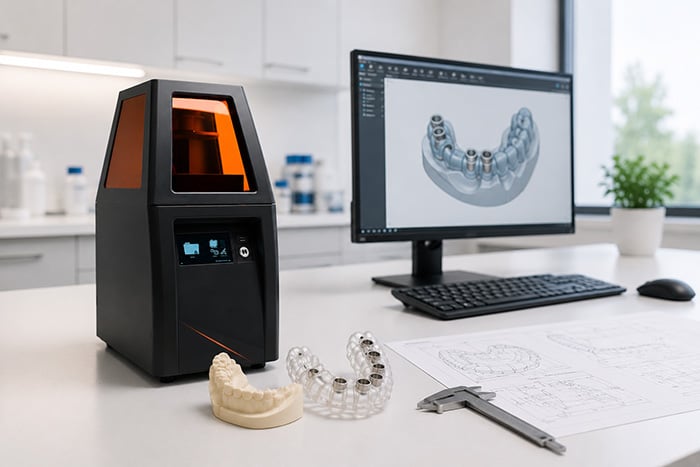
B9Creations has developed specific solutions for medical device manufacturers who need micro-scale precision combined with biocompatible material options and robust support infrastructure.
The B9 Core Med Series for Medical Applications
The B9 Core Med Series, B9 Core Series, and B9 Elite Micro Series, delivers the resolution and accuracy medical applications demand. Major medical device brands including Medtronic and Johnson & Johnson use B9Creations systems in their development and production workflows.
The system integrates seamlessly with standard medical imaging and design workflows. You can move from CT scan data to printed surgical guide in hours rather than days, accelerating your development timeline while maintaining the precision your applications require.
Material Options and Validation Support
B9Creations offers validated biocompatible materials for medical applications, backed by ISO 10993 testing documentation. For teams with specialized requirements, B9Captivate enables development of custom material profiles optimized for specific part geometries and performance requirements.
This flexibility means you're not locked into a limited material selection as your applications evolve. When new requirements emerge, you can develop and validate new material solutions without replacing your printer platform.
Future Trends in Micro 3D Printing for Medical Devices
The medical 3D printing landscape continues to evolve rapidly. Understanding emerging trends helps you make equipment decisions that remain relevant as the technology advances.
Increasing Resolution and Accuracy
Micro 3D printer resolution continues to improve as projector technology advances and optical systems become more sophisticated. Systems achieving sub-25-micron XY resolution are becoming more accessible, enabling new applications in microfluidics, drug delivery devices, and ultra-precise surgical instruments.
For surgical guide applications, these improvements translate to better anatomical fit and more detailed feature reproduction—benefits that directly impact surgical outcomes.
Expanded Material Options
Material science advances are expanding the range of biocompatible photopolymers available for medical 3D printing. New formulations offer improved mechanical properties, better sterilization compatibility, and specific performance characteristics for specialized applications.
Watch for materials with enhanced long-term biocompatibility for implantable applications, as well as materials specifically formulated for point-of-care manufacturing where speed and simplicity are priorities.
Regulatory Framework Evolution
Regulatory bodies worldwide are developing more specific guidance for 3D printed medical devices. Stay current with regulatory developments in your target markets. As frameworks mature, requirements may become more specific—and potentially more demanding—for documentation, validation, and quality control.
Getting Started with Micro 3D Printing for Surgical Guides
If you're beginning to explore micro 3D printing for surgical guide or anatomical model production, these steps will help you move from evaluation to implementation.
Define Your Requirements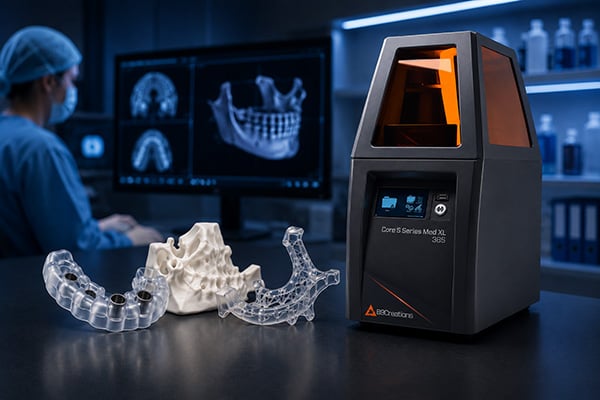
Start by documenting your specific application requirements: target resolution and accuracy, required materials and their biocompatibility needs, expected production volumes, and regulatory pathway. These requirements drive your printer selection and workflow design.
Involve stakeholders from engineering, quality, regulatory, and clinical functions in requirements definition. Each perspective contributes important considerations.
Evaluate Vendors and Technologies
Request evaluation prints of your actual part geometries from multiple vendors. Measure results against your specifications. Compare total cost of ownership including materials, maintenance, and training—not just equipment purchase price.
Ask detailed questions about reliability, support responsiveness, and any challenges encountered during implementation.
Plan Your Implementation
Develop an implementation plan that addresses equipment installation, operator training, process validation, quality system integration, and regulatory documentation. Build time for learning curve—your first prints won't match your thousandth in quality or efficiency.
Consider starting with prototyping applications before moving to production applications. This allows your team to develop expertise with lower-stakes applications before tackling regulated production scenarios.
Conclusion: Choosing the Right Micro 3D Printer for Your Medical Applications
Micro 3D printing has become an essential capability for medical device manufacturers developing surgical guides and anatomical models. The technology enables precision, speed, and customization that traditional manufacturing methods simply cannot match.
Your printer selection should prioritize the resolution and accuracy your applications require, material options that meet biocompatibility standards, and software and support infrastructure that integrates with your existing workflows. Don't make decisions based on specifications alone—test actual parts and evaluate total cost of ownership.
B9Creations offers medical device teams the precision, material flexibility, and workflow integration they need to accelerate development while maintaining the quality standards medical applications demand. The combination of high-resolution DLP technology, validated biocompatible materials, and proven medical device customer experience makes the B9 Core Series a strong option for teams serious about micro 3D printing.
FAQs about Micro 3D Printing for Surgical Guides in 2026
What resolution do I need for 3D printed surgical guides?
Most surgical guide applications require XY resolution of 50 microns or finer to accurately reproduce anatomical reference surfaces and guide features. The specific requirements depend on your application's tolerance specifications. For dental surgical guides, 35-50 micron resolution typically suffices. Orthopedic applications with fine osteotomy features may require finer resolution. Always validate printer performance against your specific part requirements.
Are 3D printed surgical guides FDA approved?
-
The FDA doesn't approve individual surgical guides but rather clears them through the 510(k) process or determines they qualify for exemption. Most patient-matched surgical guides are Class II devices requiring 510(k) clearance. The printer is one component of a validated manufacturing process that includes materials, software, and quality systems.
What biocompatible materials can I use for surgical guides?
-
Photopolymer resins with ISO 10993 biocompatibility certification are the standard choice for surgical guides. These materials must be certified for the specific type and duration of tissue contact your application involves.B9Creations offers validated biocompatible resins through the B9 Core Series, with complete ISO 10993 documentation to support your regulatory submissions, and is open to third-party materials as well.
How long does it take to print a surgical guide?
-
Print time depends on the guide's size, complexity, and your chosen resolution settings. B9Creations DLP technology prints 4x faster than many alternatives, printing parts in 20-45 minutes, helping you accelerate design iterations and meet tight production deadlines.
Can I sterilize 3D printed surgical guides in an autoclave?
-
Some biocompatible 3D printing materials tolerate autoclave sterilization, but not all. You must validate that your chosen material maintains dimensional accuracy through your specific sterilization protocol. B9Creations can help you identify materials compatible with your sterilization requirements and establish validated post-processing protocols.
What's the difference between surgical guides and anatomical models?
-
Surgical guides are functional tools that direct instrument positioning during surgery. Anatomical models are visual and tactile representations of patient anatomy used for planning, training, and communication—they don't typically contact the patient during surgery. Both applications benefit from micro 3D printing's high resolution, but surgical guides have stricter requirements for dimensional accuracy and biocompatibility.
How do I validate my 3D printing process for medical devices?
-
Process validation typically includes installation qualification (IQ), operational qualification (OQ), and performance qualification (PQ). You must demonstrate that your equipment, materials, and procedures consistently produce parts meeting specifications. Document everything: printer settings, material lot numbers, environmental conditions, measurements, and inspection results. B9Creations provides guidance to help medical device customers establish compliant validation protocols


