

Where micro additive manufacturing outperforms legacy approaches
As electronics, sensors, and electromechanical systems continue to shrink, the components that connect and assemble them must keep pace. Micro electrical connectors, tiny sockets, miniature switch components, and intricate tooling inserts for assembly and test all require feature sizes and tolerances that push the limits of conventional manufacturing. At the same time, design cycles are compressing, customization is becoming the norm, and engineering teams need more flexibility than traditional micro machining and micro molding can offer.
 High-precision micro additive manufacturing addresses these challenges head-on. By building components layer by layer from photopolymer materials, micro 3D printers can realize complex geometries and integrated functions that would be extremely difficult or impossible to produce through subtractive or molding processes alone. Platforms like the B9 Elite Series, with effective resolution under 10 microns and fine minimum wall thicknesses, provide the resolution and accuracy necessary for connectors, tooling inserts, and other micro-scale components used in demanding industrial and electronics environments.
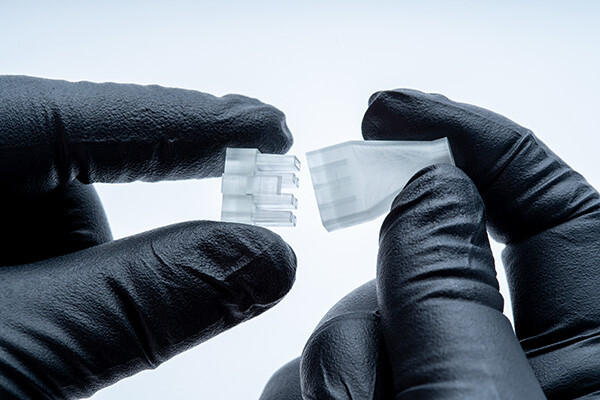
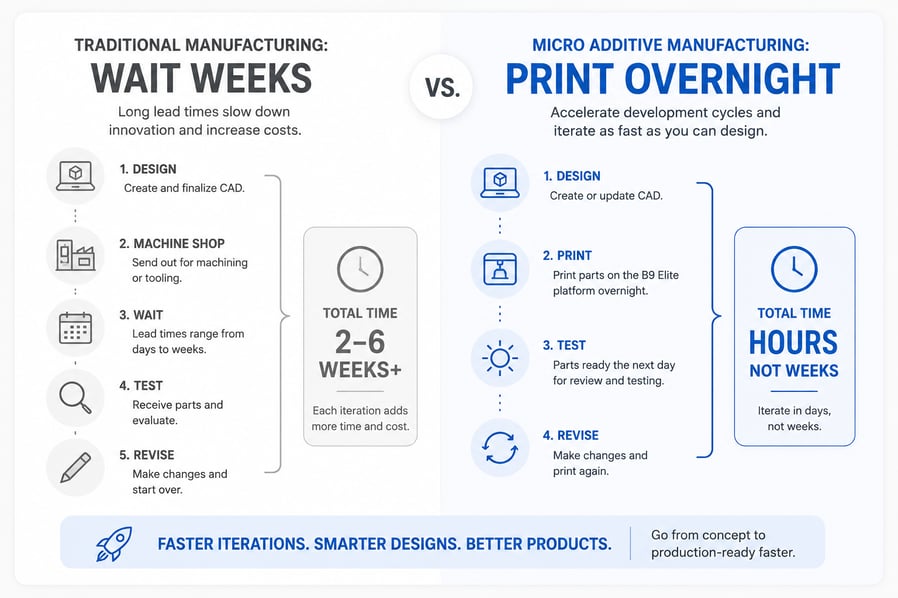
This capability is compelling in applications where design freedom and speed carry as much value as unit cost. For example, automotive and aerospace electronics teams frequently need new connector configurations and test fixtures as they iterate on control units and wiring architectures. Instead of waiting weeks for custom machined or molded components, they can print micro connector housings or precision tooling overnight, evaluate their performance, and refine the design as needed. Industry examples, such as batch-manufactured micro connectors produced on high-resolution systems, demonstrate how micro additive manufacturing is already used to accelerate development cycles in electronics.
Beyond prototyping, high-precision micro additive manufacturing increasingly supports end-use production. Many micro electrical connectors and tooling components serve niche or rapidly evolving applications, where volumes may be in the hundreds or low thousands per year. In these ranges, the elimination of tooling costs – combined with the ability to update designs digitally at any time – makes micro 3D printing economically attractive. Manufacturers can maintain digital inventories of multiple connector or tooling variants, printing only what is needed when it is needed, while still meeting tight dimensional and performance requirements.
By embracing high-precision micro 3D printing as a core capability, organizations gain not just a new manufacturing method, but a fundamentally more agile approach to connector and tooling design. The transition from static, tooling-bound geometries to digitally native, rapidly iterated micro components enables better fit, function, and reliability – and ultimately supports more compact, capable, and differentiated products in the market.
Comparing micro additive to traditional micro machining and molding
Once engineers understand the core capabilities of micro additive manufacturing, the next natural question is whether it can truly replace or augment traditional processes like micro machining and micro molding for critical components such as electrical connectors and tooling inserts. The answer depends on the specific application, but in many cases, high-precision micro 3D printing delivers a combination of design freedom, speed, and cost structure that legacy processes cannot match – especially in low- to mid-volume production.
Where Traditional Manufacturing Excels
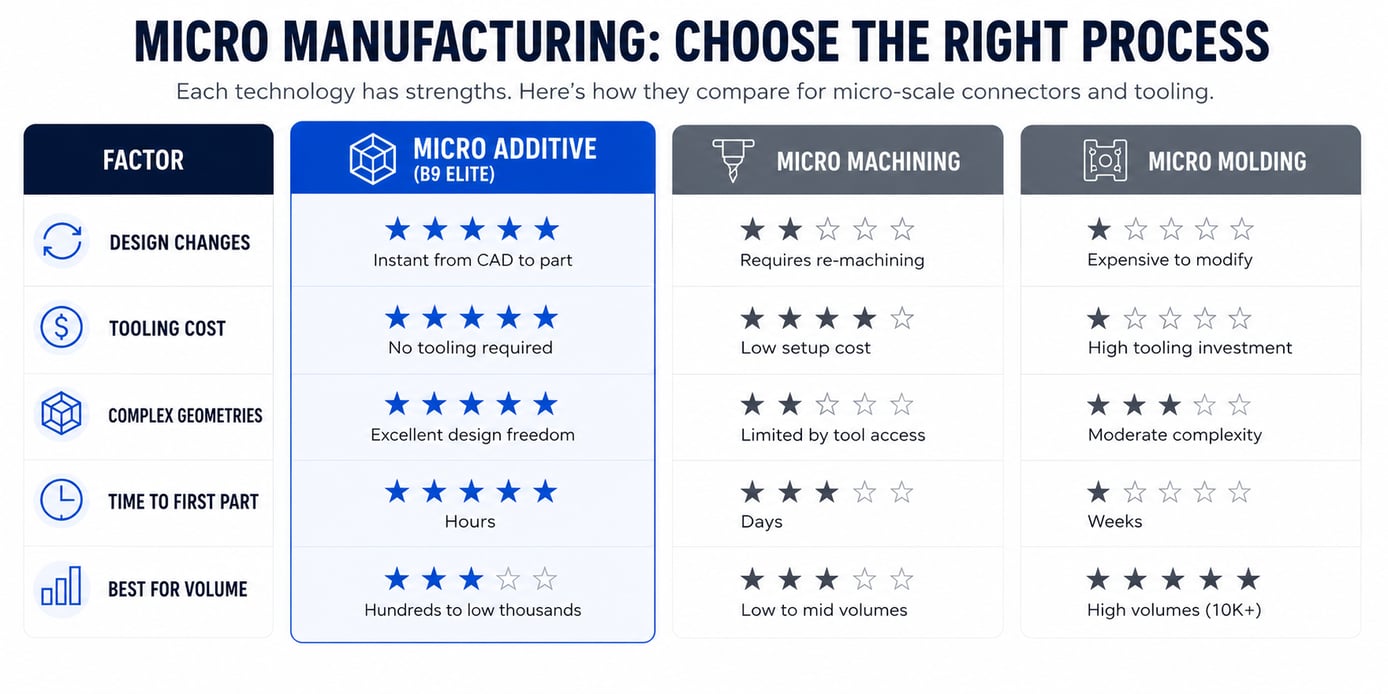
Traditional micro machining excels at rigid metal components, particularly where extremely tight tolerances and well-established materials are required. However, fabricating intricate internal geometries, undercuts, or lattices is either impossible or demands multiple operations and complex fixturing. Micro injection molding offers excellent repeatability and cost per part at scale, yet up-front tooling costs, long lead times, and the difficulty of iterating on tool designs limit its agility.
High-precision micro 3D printing platforms – including ultra-fine DLP and projection micro stereolithography systems like the B9 Elite Micro – invert many of these tradeoffs. Instead of investing heavily in hard tooling before validating a design, teams can move directly from CAD to functional micro parts. This is particularly powerful for micro electrical connectors, sockets, and housings, where pin spacing, insulation geometry, and integration with surrounding structures are constantly evolving.
 How Micro Additive Changes the Equation
From a performance standpoint, micro additive manufacturing now achieves feature sizes and tolerances that approach or rival micro molding in many scenarios.
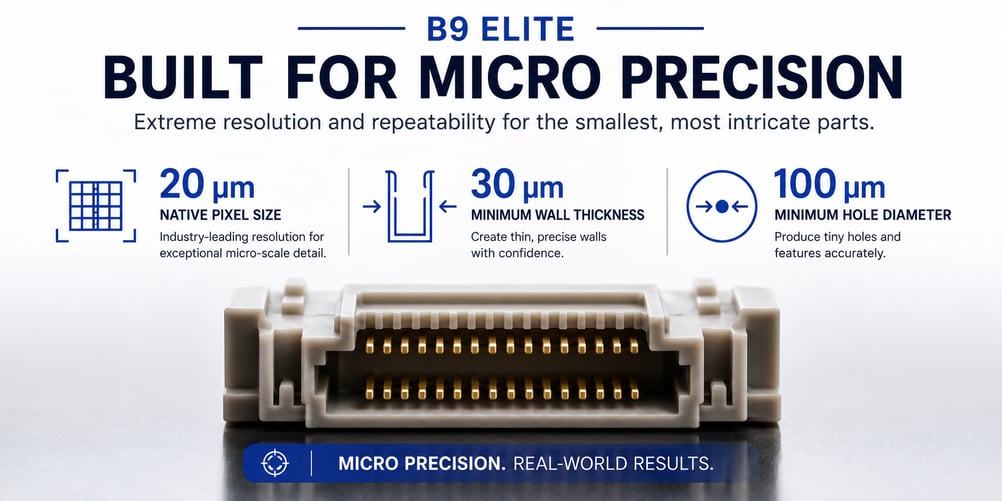
For example, B9Creations’ Elite Micro platform offers a native pixel size of 20 microns, effective resolution of 10 microns and can realize wall thicknesses down to approximately 30 microns. Combined with carefully validated workflows, this level of precision is sufficient for a wide range of micro connectors, microfluidic fixtures, and tooling inserts used for test and assembly.
At the same time, micro additive offers unique advantages that traditional processes cannot easily replicate. Engineers can consolidate assemblies by integrating strain reliefs, keying features, cable management channels, or identification marks directly into connector bodies or tooling blocks – without adding extra machining operations or mold complexity. Cooling channels, vacuum paths, or sensor pockets can be woven through tooling inserts in ways that are impractical with subtractive methods.
This design freedom not only improves performance but can also simplify downstream processes such as assembly, testing, and maintenance.
The Hybrid Manufacturing Strategy
Of course, the goal is not to replace micro machining and micro molding entirely. Instead, high-precision micro 3D printing complements these methods, giving teams a flexible, digital tool for rapid development, customization, and on-demand production. For many organizations, the optimal strategy is a hybrid one: use micro additive to prototype and validate designs, then either continue producing end-use parts where volumes justify it or transition to micro molding with tools informed by printed iterations. In all cases, the ability to move from CAD to physical, micro-scale components in hours rather than weeks fundamentally shifts what is possible in connector and tooling design.
Ensuring reliability and quality in micro additive manufacturing
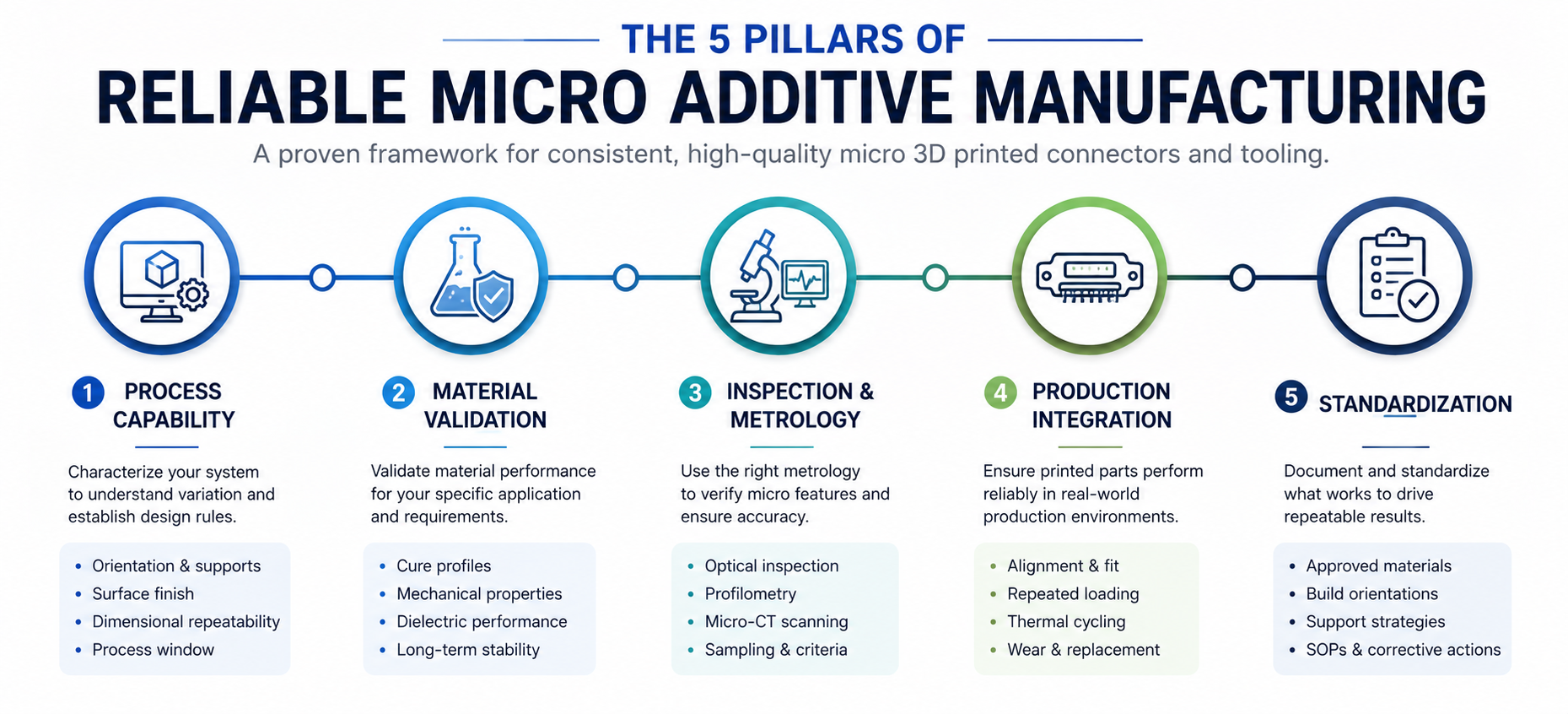
For micro electrical connectors and high-precision tooling, reliability is non-negotiable. Any variation in geometry, surface finish, or material properties can lead to intermittent electrical contact, premature wear, or fixture misalignment that ripples through production. To confidently deploy micro 3D printed components into demanding environments, manufacturers must treat additive not as a one-off prototyping method, but as a fully engineered process with robust quality controls.
The foundation of reliability is process capability. Begin by characterizing your micro additive system across its working envelope. For a platform like the B9 Elite Micro, this includes evaluating the impact of orientation and support strategy on key features and quantifying surface roughness in regions that interface with contacts or mating parts. Over time, this data informs design rules and preferred build configurations that consistently yield in-tolerance parts.
Material behavior at the micro scale also needs careful attention. Photopolymer resins, whether used in B9Creations systems or other platforms, can exhibit curing gradients through the cross-section of a part, especially near thick-to-thin transitions. Establish standardized material parameters and post-cure recipes for each resin and part family, then validate how these settings influence mechanical properties, dielectric performance, and long-term stability. For connector applications, this may involve accelerated aging tests, repeated mating cycles, and voltage breakdown testing to ensure that micro-printed insulators and housings maintain performance over time.
Inspection and metrology are where micro additive manufacturing often diverges from conventional workflows. Traditional calipers and CMMs cannot fully capture internal micro features, thin walls, or complex 3D paths. Instead, high-magnification optical systems, profilometry, or micro-CT scanning may be required to validate that micro printed connectors and tooling inserts match their digital twins. Once suitable measurement methods are in place, define sampling plans and acceptance criteria that balance risk, throughput, and cost, focusing on the most critical features for functionality.
Reliability also depends on how micro 3D printed parts are integrated into broader production systems. For example, a micro 3D printed connector test fixture used in electronics manufacturing might combine printed housings with standard metal pins and off-the-shelf hardware. Here, the printed portion must maintain precise alignment under repeated loading, thermal cycling, and operator handling. Other applications underscore the importance of designing fixtures and tooling to distribute loads, avoid stress risers, and facilitate easy replacement of wear components.
To scale micro additive manufacturing beyond isolated use cases, codify everything you learn into standard operating procedures and design guides accessible to your broader engineering and operations teams. Document preferred materials for each application, template build orientations, support strategies, inspection routines, and failure modes with their corresponding corrective actions. Over time, this institutional knowledge transforms micro 3D printing from an experiment on the lab bench into a predictable, high-yield production resource – one that keeps your connector and tooling designs ahead of competitors still bound by traditional constraints.
Ultimately, the value of high-precision micro additive manufacturing lies in the new products and processes it makes possible. From ultra-compact electrical connectors that fit where no off-the-shelf part can go, to conformal cooling channels and integrated sensing in tooling that unlock new performance levels, the organizations that master micro 3D printing today will define the benchmarks for reliability and innovation in tomorrow’s micro-scale systems.


