

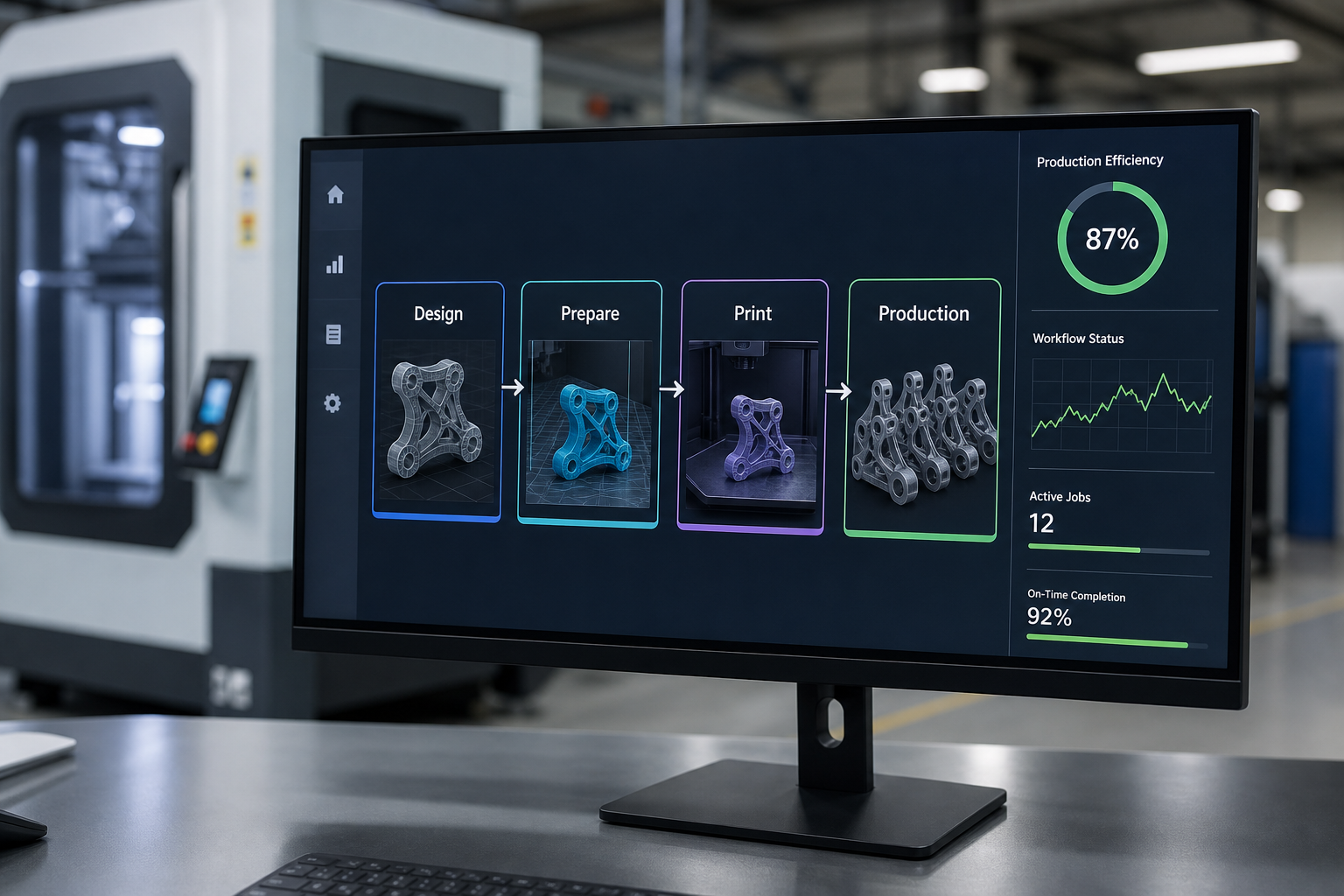
B9Creations connects design, additive manufacturing, automation, and production systems to turn 3D printing into an integrated manufacturing workflow.
A Successful Print Isn't the Same as a Successful Workflow.
Additive manufacturing can solve a technical problem and still fail operationally.
A part may print perfectly, but require an expert to manually prepare every build. Files may move between disconnected systems. Operators may repeatedly select parameters that could be automated. Production data may live separately from ERP, MES, quality, and traceability systems.
As additive moves from experimentation toward production, those gaps become increasingly important.
B9Creations works with organizations across industrial manufacturing, aerospace, medical, dental, and other demanding applications to engineer the software and workflow surrounding the printer—connecting design to print, embedding application expertise, automating repetitive decisions, and integrating additive into existing production systems.
The objective isn't simply easier software.
It's making additive manufacturing work as part of the way your organization already designs, manufactures, controls, and scales products.
The Approach
Prove the Application. Then Engineer the Workflow Around It.
Software requirements change as an additive application matures.
B9Creations' Additive Advantage Model provides a structured approach for moving from:
FEASIBILITY → PILOT-TO-SCALE → PRODUCTION
At feasibility, the focus may be proving that the geometry, material, process, and economics work.
During pilot, repeatable workflows begin to matter: How should parts be oriented and supported? Which parameters should operators use? What expertise can be standardized rather than manually repeated?
At scale, manual steps become bottlenecks. File preparation, slicing, printer management, production scheduling, quality data, serialization, and traceability need to become repeatable across people, machines, and locations.
And in production, additive can no longer operate as an island. It may need to connect with the organization's broader MES, ERP, quality, automation, and production-management ecosystem.
That's where B9X software and integration capabilities come in.
Additive Advantage proves and develops the process. B9[X] turns that process into an integrated workflow.
 The Solution
From Design File to Production System
Depending on the application, B9Creations software development can range from simplifying a single workflow to integrating an entire additive fleet into enterprise manufacturing systems.
DESIGN-TO-PRINT INTEGRATION
The most effective workflow may begin before a file ever reaches traditional print-preparation software.
In jewelry manufacturing, B9Creations worked with Stuller to integrate its additive technology with CounterSketch, a digital custom-design environment used to create customer-specific jewelry.
Rather than treating design and additive manufacturing as separate workflows, the integration helped connect the digital design process directly to B9 printing—reducing the steps between a finished design and a production-ready file.
The result is a model that applies far beyond jewelry:
Design → Prepare → Print
with fewer handoffs, fewer opportunities for error, and less specialized additive expertise required from the user.
Application Expertise, Built Into the Software
Turning Expert Knowledge Into a Repeatable Workflow
Sometimes integration isn't primarily about connecting two systems.
It's about capturing what an expert knows and making that knowledge repeatable.
Kulzer, one of the world's largest dental suppliers, partnered with B9Creations to develop a white-labeled digital manufacturing solution that combined custom hardware and software with dental materials and workflows.
B9Creations developed a custom software Expert System that incorporated the expertise of senior dental technicians into the user experience and automated print preparation across applications such as dentures, models, and surgical guides.
The resulting workflow reduced software interaction to three clicks and operator training to one day, while supporting a turnkey platform that ultimately grew to more than 1,000 systems in the field.
Kulzer's cara Print documentation also describes an open digital workflow with included CAM software and compatibility with common dental CAD workflows.
The value wasn't simply faster slicing.
B9 helped turn specialized dental knowledge into software that could be deployed repeatedly across a global user base.
From Manual Print Preparation to Automation
Remove the Steps That Don't Need a Person.
As an application scales, even small manual tasks multiply.
Importing files. Orienting parts. Applying supports. Selecting materials and parameters. Slicing. Transferring files. Choosing printers. Starting jobs.
B9Create already supports automated orientation and support workflows, slicing, print libraries, printer connectivity, queues, and direct file transfer to connected printers.
For custom production environments, B9 can go further.
Software can be developed around known product families and validated workflows so that repeatable decisions are automated rather than recreated by each operator.
A CAD file can move through defined preparation and slicing rules and be delivered to the appropriate printer with dramatically less manual intervention.
That changes the role of software from a tool the operator uses to part of the manufacturing process itself.
 Production Systems That Talk to Each Other
Connecting Additive to the Factory
For Poly6 Technologies and Consolidated Precision Products, additive manufacturing became part of a highly demanding aerospace production process.
The relationship began with off-the-shelf B9 hardware but expanded as the application matured into industrial production.
B9Creations developed a first-in-market software toolset to optimize the interaction between Poly6's unique materials and printers, then developed software integrations with Poly6's manufacturing execution system (MES) to track and control the production lifecycle.
As the operation scaled, the software ecosystem expanded to support the needs of a growing production fleet.
That type of integration can connect additive manufacturing with the broader systems required for industrial production, including:
MES & ERP INTEGRATION
Connect additive activity with existing production-management systems.
AUTOMATED FILE PREPARATION
Move defined CAD files through validated slicing and print-preparation workflows with reduced operator intervention.
SERIALIZATION & TRACEABILITY
Maintain the identity and production history of parts as they move through the manufacturing process.
FLEET MANAGEMENT
Manage jobs and workflows across multiple additive systems rather than treating each printer as an isolated machine.
PROCESS CONTROL
Standardize validated parameters and workflows across operators, printers, and production environments.
B9's public micro-manufacturing offering specifically includes CAM optimized around customer product families and workflows, production-management-system integration, internal automation, and custom software development.
Different Workflows. The Same Objective.
Make the Technology Disappear Into the Process.
The best additive workflow doesn't require an operator to become an additive manufacturing expert.
For a jewelry manufacturer, that can mean moving from a customer-specific digital design toward the printer without unnecessary handoffs.
For a dental company, it can mean embedding the knowledge of experienced technicians into CAM software so users can prepare validated applications in just a few clicks.
For an aerospace manufacturer, it can mean connecting CAD preparation, slicing, printers, production data, serialization, and MES into a controlled manufacturing ecosystem.
The applications are completely different.
The objective is the same:
Put the expertise into the workflow—not on the operator.
 From Feasibility to Digital Production
Software integration also evolves with the application.
FEASIBILITY
Prove the part, material, process, and business case.
At this stage, flexibility matters. Engineers need the ability to iterate quickly and understand which variables drive performance.
PILOT
Turn successful experiments into repeatable workflows.
Define print preparation, process parameters, operator steps, quality requirements, and production data.
SCALE
Automate what has been proven.
Reduce manual file preparation, standardize processes, manage multiple printers, and introduce traceability and production controls.
PRODUCTION
Integrate additive into the manufacturing ecosystem.
Connect workflows with MES, ERP, quality systems, automation, serialization, and other enterprise infrastructure.
The goal isn't automation for automation's sake.
First prove the process. Then automate what works.
That distinction is important. Automating an unstable process simply scales the instability.
The Additive Advantage Model establishes what works. B9X software and workflow integration can then make that proven process simpler, repeatable, traceable, and scalable.
Software Engineered Around the Application
B9Creations can develop and integrate:
CUSTOM CAM
Application-specific print preparation, workflows, and user experiences
EXPERT SYSTEMS
Capture specialized knowledge and embed it into repeatable software workflows
DESIGN-TO-PRINT INTEGRATION
Connect upstream CAD and design systems directly to additive manufacturing
WORKFLOW AUTOMATION
Automate file preparation, slicing, job creation, and other repeatable production steps
MES & ERP INTEGRATION
Connect additive manufacturing with existing enterprise production systems
SERIALIZATION & TRACEABILITY
Track parts, builds, printers, parameters, and production history
FLEET MANAGEMENT
Coordinate workflows across multiple printers, operators, and locations
CUSTOM DEVELOPMENT
Build around requirements standard additive software wasn't designed to address
 The Result: From Printing Parts to Running a Production Process
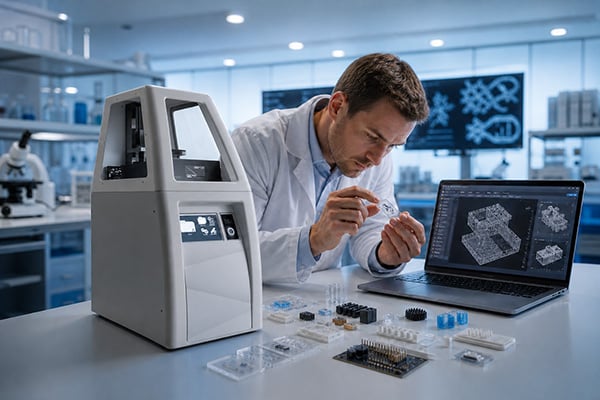
Across applications as different as custom jewelry, dental manufacturing, and flight-critical aerospace production, B9Creations has used software to remove friction between design, expertise, equipment, people, and production systems.
The result can be fewer manual steps.
Less dependence on individual operator expertise.
More consistent execution.
Better traceability.
Faster movement from digital design to physical part.
And a workflow capable of evolving as the application moves from feasibility to pilot, scale, and production.
Because at production scale, the printer shouldn't be the center of the workflow.
It should simply be part of it.
Make Additive Work With the Way You Manufacture.
Whether you need to connect design software directly to your printers, automate a validated workflow, embed application expertise into CAM, or integrate an additive fleet into your production-management systems, B9Creations can engineer the software around your process.


