

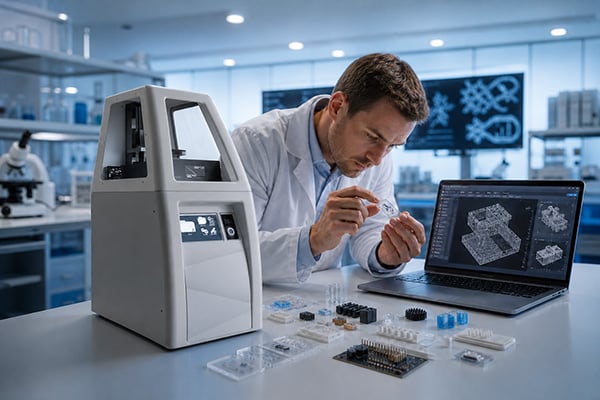
Micro 3D printing is changing how academic and research laboratories develop micro-scale devices, prototypes, and functional components. Whether you're designing microfluidic chips, biomedical devices, electronic connectors, or precision manufacturing tools, selecting the right printing technology requires understanding far more than resolution alone. This guide explains how micro 3D printing works, what performance specifications actually matter, how it compares to traditional manufacturing methods, and what researchers should evaluate when choosing a system for their lab. It also explores the materials, software, applications, and total cost considerations that influence long-term success in academic and R&D environments.
What Is Micro 3D Printing and Why Does It Matter for Academic Labs?
Micro 3D printing—sometimes called microscale additive manufacturing—refers to printing technologies capable of producing parts with features smaller than 100 microns. This capability is reshaping how academic labs approach research in fields ranging from biomedical engineering to microelectronics.
Traditional manufacturing methods like micro-injection molding require expensive tooling and long lead times. Micro 3D printing eliminates those barriers, allowing researchers to go from digital design to physical prototype in hours rather than weeks.
For space-constrained labs in universities or corporate R&D departments, compact micro 3D printers also solve a practical problem. You don't need a dedicated cleanroom or industrial floor space to produce precision parts.
How Does Micro 3D Printing Work at the Microscale?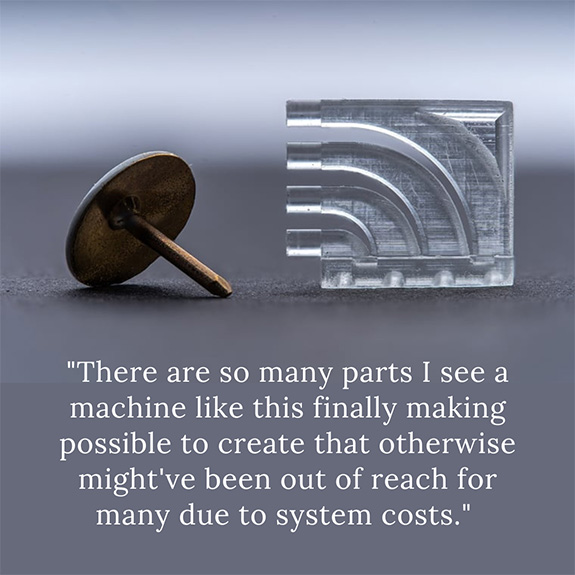
Most micro 3D printers use a technology called Digital Light Processing (DLP). A high-resolution projector flashes UV light onto a vat of photopolymer resin, curing an entire layer at once. This differs from SLA (stereolithography), which traces each feature with a laser beam point by point.
Because DLP cures whole layers simultaneously, print time depends more on the number of layers than on part complexity. You can print one intricate part or dozens in the same amount of time, making batch fabrication highly efficient.
The precision of DLP printing depends on pixel size. Micro 3D printers typically achieve native pixel sizes between 10 and 25 microns, with some systems offering effective resolutions even finer through advanced anti-aliasing techniques.
Why Does Layer-Based Curing Speed Up Research?
In a university lab, graduate students and researchers juggle coursework, teaching, and grant deadlines. Waiting days for a single prototype slows progress and limits how many design iterations you can test.
DLP technology changes this dynamic. Same-day design-print-test cycles become routine. Batch fabrication of experimental cohorts with identical geometry ensures statistical validity. Faster convergence on viable designs means more time for hypothesis testing rather than fabrication troubleshooting.
What Resolution and Precision Can You Expect from Micro 3D Printers?
Nominal resolution numbers on spec sheets can be misleading. What matters for research is repeatable, effective resolution—the ability to produce the same fine features reliably across prints and across machines.
High-quality DLP micro 3D printers operate at effective resolutions of approximately 10–50 microns, with validated dimensional tolerances of ±50 microns (±0.002 inches). In third-party testing, dimensional variation between printed parts and their CAD models has been measured at scales comparable to a single human cell.
This level of precision means fine channels and small features remain open and functional. Parts behave consistently across experimental runs. You can trust geometry as a controlled variable rather than a source of noise in your data.
How Do Resolution and Pixel Size Relate to Feature Size?
Feature size is typically a multiple of the resolution. A 10-micron resolution can produce features of approximately 50 microns, while a 2-micron resolution can achieve features around 10 microns. Surface finish ranges between 0.5 to 2 microns RA, depending on the orientation of the surface.
For academic applications like microfluidics, neural interfaces, or electronic connector prototyping, these specifications determine whether your designs will actually function as intended.
 How to Evaluate Micro 3D Printers for Space-Constrained Labs
Academic and R&D labs rarely have unlimited floor space. When evaluating a micro 3D printer, consider not just the build volume but also the overall footprint and installation requirements.
Compact systems that fit on a standard lab bench eliminate the need for dedicated rooms or costly renovations. Look for printers that can pass through standard doors and fit in conventional elevators if you anticipate moving the equipment.
What Build Volume Do You Actually Need?
Larger isn't always better. Micro 3D printers often have smaller build volumes than industrial systems, but this is intentional. A build volume of 38 x 22 x 127 mm may sound small, but for microscale parts—electronic connectors, microfluidic chips, medical device components—it's more than sufficient.
Smaller build volumes also mean less resin in the vat, reducing material waste and lowering costs when working with expensive specialty resins.
Why Material Flexibility Matters for Research Applications
Many research projects depend on materials that aren't commercially standardized: custom photopolymers, experimental elastomers, or biocompatible resins with specific mechanical properties. Closed material ecosystems force researchers to compromise their experiments to fit the printer.
Open systems allow the printer to adapt to your research. Look for platforms that support third-party materials and offer software-level control over exposure, curing profiles, and release forces. This capability is critical in fields like biomedical engineering, chemistry, and materials science.
B9Creations designs its platforms to support third-party and custom materials, with software tools like B9Captivate enabling tailored chemistry and application-specific performance. This material development toolkit lets you optimize settings for custom materials and part geometry.
What Materials Are Available for Micro 3D Printing?
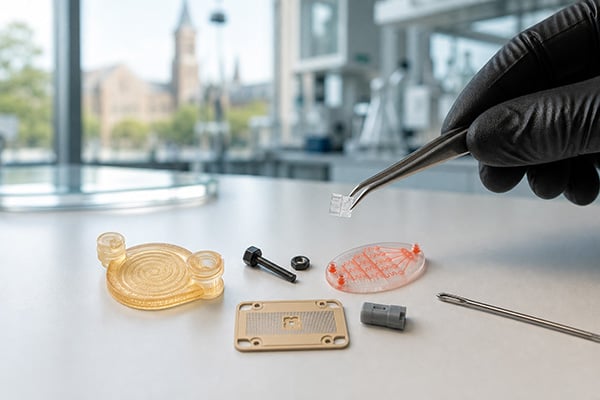
Materials include rigid resins for structural parts, flexible resins for soft components, and transparent resins for optical applications or microfluidics. Specialty options include biocompatible resins meeting ISO 10993 requirements, bio-inks for regenerative medicine, ceramic-filled photopolymers, flame-retardant resins for electronic housings, and castable resins for jewelry and dental applications. The mechanical properties of printed parts approach those of traditional injection molding materials.
 What Are the Best Applications for Micro 3D Printing in Academic Labs?
Micro 3D printing has found traction across multiple research domains. The technology excels wherever small scale, geometric complexity, and rapid iteration intersect.
Electronic Connector Prototyping
Electronic connectors present a perfect use case for micro 3D printing. These components feature arrays of tiny holes, thin walls, and precise spacing—geometries that are expensive and time-consuming to produce through traditional methods.
With micro 3D printing, you can prototype connector designs in hours and iterate through multiple versions in a single day. Spacing between connector teeth can be as small as 280 microns, and arrays of through-holes as small as 130 microns are achievable.
Microfluidics and Lab-on-a-Chip Devices
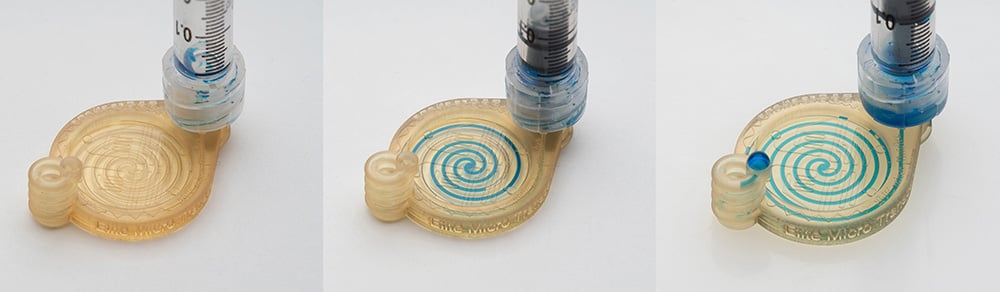
Microfluidic devices require channels with precise dimensions and smooth surfaces. DLP-based micro 3D printing can produce channels that remain open and functional, unlike some additive processes that over-cure and close internal features.
For academic labs developing diagnostic devices, drug delivery systems, or cell-sorting technologies, micro 3D printing removes fabrication as a limiting factor in experimental design.
Biomedical Devices
Medical device research demands extreme precision. Neural interfaces, for example, may need to wrap around nerves measuring only 180 microns in diameter. Traditional manufacturing methods simply cannot achieve these geometries cost-effectively.
Research teams at institutions like the University of Colorado have used B9Creations DLP printers to fabricate nerve cuffs with feature resolution on the order of 15 microns, using silicone-based biocompatible resins. After seven days in vivo, the devices showed no signs of tissue damage or adverse biological response.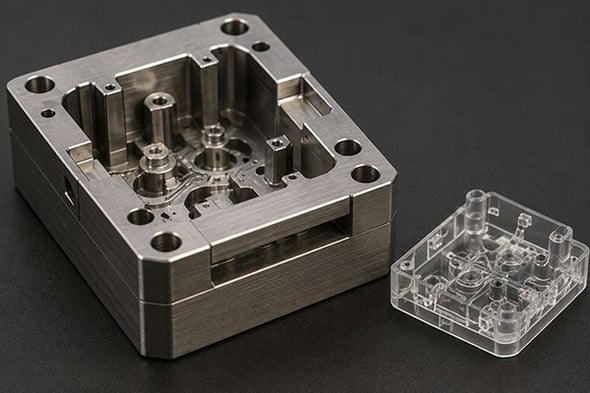
How Does Micro 3D Printing Compare to Traditional Manufacturing Methods?
Micro 3D printing and micro-injection molding serve different points in the product development lifecycle. Understanding when each approach makes sense can save time and money.
Cost Crossover Points
The cost of a single-cavity complex micro mold can exceed $100,000. Turnaround time for tooling can stretch to months. For prototyping or low-volume production, these economics rarely make sense.
With micro 3D printing, you can print tens of thousands of parts before the amortization of an injection mold is realized. If you only need hundreds of parts, micro 3D printing delivers significant cost advantages.
When Does Injection Molding Still Make Sense?
Once you've validated a design and need to produce hundreds of thousands of identical parts, injection molding typically becomes more economical. The key is using micro 3D printing to get to that validated design faster and cheaper.
What Software Features Should Academic Labs Look For?
The printer is only part of the equation. Software determines how efficiently you can go from CAD model to printed part and how much control you have over the process.
Print Preparation and Support Generation
Good software automatically slices models, generates support structures, and optimizes orientation for print quality. For micro-scale parts, look for software with features specifically designed for small geometries.
B9Creations' B9Create software includes micro-specific CAM features that streamline the workflow from design to finished part. The software handles orientation, support generation, and production automation.
Material Profile Customization
Open-source or open-parameter software allows you to fine-tune parameters like exposure time, layer thickness, and lift speeds. This flexibility is essential when working with non-standard materials or pushing the limits of resolution.
 What Post-Processing Is Required for Micro 3D Printed Parts?
Every resin-based 3D printing process requires post-processing. Understanding these steps helps you plan realistic timelines and workspace requirements.
Cleaning and Curing
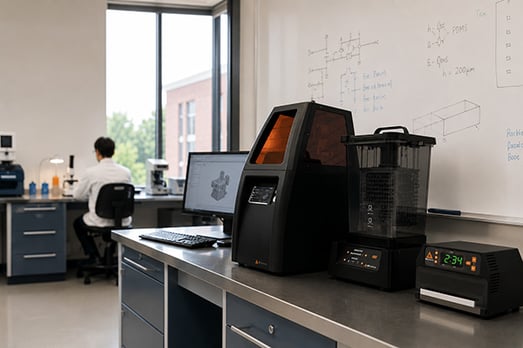
After printing, parts need washing to remove uncured resin, typically using isopropyl alcohol or a similar solvent. Following cleaning, parts are cured under UV light to fully harden the material and achieve final mechanical properties.
Automated post-processing units can streamline these steps. Integrated washing and curing stations reduce hands-on time and ensure consistent results across prints.
Support Removal and Finishing
Support structures anchor parts during printing but need removal afterward. For micro-scale parts, this step requires care—fine features can be damaged by aggressive handling. Some materials allow support removal with solvents rather than mechanical cutting.
How to Assess Total Cost of Ownership for a Micro 3D Printer
The sticker price of a printer tells only part of the story. Academic labs should evaluate total cost of ownership, including consumables, maintenance, and training.
Material Costs and Waste
Micro 3D printing uses very little material per part, which matters when working with expensive specialty resins. Look for systems that minimize resin waste and allow unused resin to be reused for subsequent prints.
Service and Support
Research can't wait for extended downtime. Evaluate the service packages offered by different manufacturers. B9Creations includes an annual service package with installation, training, hot swap programs for equipment failures, and master classes for advanced users.
What Selection Criteria Should Aerospace and Manufacturing Firms Consider?
Beyond academic labs, aerospace and manufacturing firms face additional requirements when selecting micro 3D printing systems.
Repeatability Across Production Runs
For manufacturing applications, consistency matters as much as resolution. Parts printed today need to match parts printed next month. Look for systems with validated dimensional tolerances across fleets of machines.
Material Certification and Traceability
Aerospace applications may require certified materials with documented properties and traceability. Some manufacturers offer materials specifically formulated and tested for production use.
How B9Creations Addresses Academic and R&D Requirements
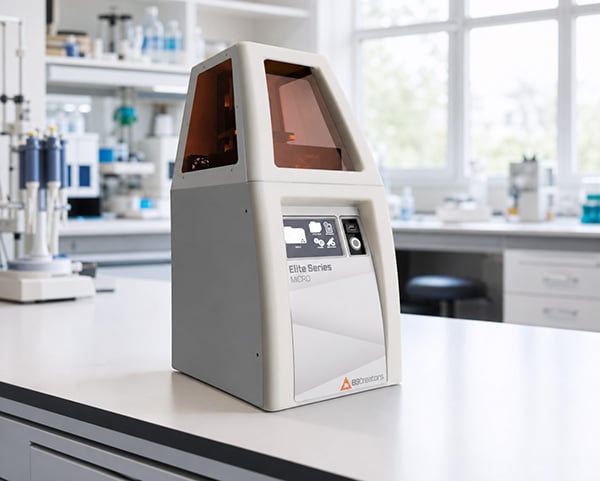
B9Creations' B9 Elite Series delivers micro 3D printing capability designed specifically for academic, medical, and industrial research environments. The Elite Micro platform offers native pixel size of 20 microns, effective resolution down to 10 microns, with wall thicknesses down to 30 microns and holes down to 100 microns.
The system is ready to print in 15 minutes out of the box with factory startup assistance included. It never requires user calibration, removing a common source of variability and frustration in research settings.
Perhaps most importantly for budget-conscious academic departments, B9Creations delivers this performance at approximately one-fourth the cost of competing high-end micro 3D printers. More than 220 research papers worldwide cite B9Creations technology for applications ranging from microfluidics and biomedical research to materials science and advanced manufacturing.
 Getting Started with Micro 3D Printing in Your Lab
If you're considering micro 3D printing for your academic lab or R&D team, start by defining your application requirements. What feature sizes do you need? What materials will you work with? How many iterations per day would accelerate your research?
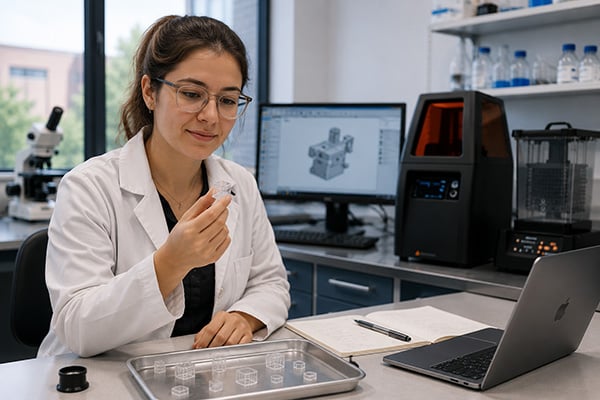
Most manufacturers, including B9Creations, offer sample parts and benchmark prints at no cost to prospective customers. Evaluating actual printed samples against your design requirements is the most reliable way to assess whether a system will meet your needs.
Conclusion: Is Micro 3D Printing Right for Your Academic Lab in 2026?
Micro 3D printing has moved beyond novelty to become essential research infrastructure for labs working at the microscale. DLP-based systems deliver the speed, precision, and material flexibility that academic research demands.
For space-constrained R&D teams, compact systems eliminate installation barriers. For budget-conscious departments, competitive options like B9Creations deliver high-end performance without high-end costs. And for researchers pushing the boundaries of miniaturization, micro 3D printing removes fabrication as a constraint on scientific thinking.
When you can trust that a design will print accurately, consistently, and in the right material, you're free to focus on hypotheses, validation, and discovery. That's the real value of micro 3D printing for academic labs in 2026.
FAQs about Micro 3D Printing for Academic Labs in 2026
What resolution can micro 3D printers achieve for academic research?
-
High-quality micro 3D printers achieve effective resolutions of 10–50 microns with dimensional tolerances of ±50 microns. B9Creations' Elite Micro delivers native 20-micron pixel size with 10-micron effective resolution using FAST technology.
How much does a micro 3D printer cost for a university lab?
-
Costs vary significantly based on resolution and capability. B9Creations offers micro 3D printing solutions at approximately one-fourth the cost of competing high-end systems, making the technology accessible to academic budgets.
What materials can academic labs use with micro 3D printers?
-
Options include rigid, flexible, transparent, and biocompatible resins. B9Creations supports both proprietary and third-party materials, giving researchers freedom to work with custom photopolymers and experimental formulations.
How long does it take to print micro-scale parts?
-
DLP micro 3D printers cure entire layers at once, so print time depends on part height rather than complexity. However, B9Creations technology enables same-day design-print-test cycles for most research applications, with print speeds in minutes to an hour.
Can micro 3D printing produce parts for electronic connector prototyping?
-
Yes. Micro 3D printing excels at electronic connector prototypes with features like arrays of 130-micron through-holes and 280-micron spacing between connector teeth. B9Creations systems deliver the precision required for these demanding geometries.
What post-processing do micro 3D printed parts require?
-
Parts need washing in solvents, like isopropyl alcohol, to remove uncured resin, support removal, and UV curing to achieve final properties. Automated post-processing stations from manufacturers like B9Creations streamline these steps for consistent results.


